Search engine optimization, usually shortened to SEO, is the practice of earning visibility in the unpaid results that appear when someone types a query into a search engine. In Morocco that search engine is almost always Google, and the stakes are high: when a traveler in London looks for a riad in Marrakech, when a buyer in Casablanca compares prices for an appliance, or when a procurement manager in Paris sources a textile supplier in Tangier, the first organic results capture the bulk of the attention and the clicks. We help English-speaking and international businesses claim those positions for the queries that matter to their growth, in a market that has its own language mix, its own mobile habits, and its own local-search behavior. This page explains what SEO is, how Google decides who ranks, the method we follow, and why organic search remains one of the most durable investments you can make in Morocco.
What SEO is and why it matters in Morocco
SEO is the work of making a website easy for search engines to find, understand, and trust, so that it appears for the right searches at the right moment. It is not a trick or a one-time setting. It is a continuous discipline that combines technical health, useful content, and external reputation. When it is done well, you stop paying for every visit and start receiving a stream of qualified traffic that compounds over time.
In Morocco the case for SEO is especially strong for three reasons.
- Google dominates. Google holds well above 95% of the search market in Morocco, far ahead of Bing or any local alternative. Optimizing for Google is, for all practical purposes, optimizing for search in this country.
- The market is mobile-first. Most Moroccans reach the web through a smartphone, often on a mobile data plan. A site that is slow on a mid-range Android phone, or that breaks on a small screen, loses customers before the content even loads. Google also indexes the mobile version of your site first, so mobile performance is not optional.
- Intent is high and local. People who search are already looking for something specific. A query like “best hammam in Marrakech” or “grossiste cosmétique Casablanca” signals a clear need. Ranking for these terms puts you in front of buyers at the exact moment they are deciding.
For an international company selling to or operating in Morocco, organic search is the channel that keeps working after the campaign budget is spent. A page that ranks today will usually keep ranking tomorrow, which is the opposite of paid advertising where visibility disappears the moment you stop paying.
How Google ranks pages: the three pillars
Answer first: Google ranks pages by weighing relevance, technical quality, and authority. No single factor wins on its own. A page that is relevant but slow, or authoritative but irrelevant, will struggle. The strongest results score well on all three.
Relevance
Relevance means the page genuinely answers the searcher’s question. Google reads your content, the words you use, the structure of your headings, and the related topics you cover. It also reads signals of intent: someone typing “buy” wants a product page, while someone typing “how to” wants a guide. Matching the format to the intent is half the battle. Keyword stuffing does the opposite ; modern Google rewards natural, complete, helpful writing.
Technical quality
Technical quality is whether Google can crawl, render, and index your pages without friction, and whether real users have a smooth experience. This includes site speed and Core Web Vitals, mobile usability, a clean URL structure, working internal links, valid structured data, secure HTTPS, and the absence of crawl traps or broken pages. A technically broken site can hold back even excellent content.
Authority
Authority is Google’s estimate of how trustworthy and well-regarded your site is. The clearest external signal is backlinks: links from other reputable websites act like votes of confidence. Brand mentions, consistent business information across the web, and a track record of helpful content all feed into this. Authority is the slowest pillar to build, which is precisely why it protects your rankings once you have it.
Our SEO method
We run SEO as a clear, repeatable process so you always know what is happening and why. You can see how this fits into the wider service on the home page.
- Audit. We start with a full technical and content audit: crawlability, indexing, speed, mobile usability, site structure, existing rankings, and competitor positions. The audit tells us what is holding the site back and where the fastest wins are.
- Keyword and intent research. We map the searches your audience actually performs, in the languages they use, and group them by intent. This becomes the blueprint for which pages to create or improve.
- On-page optimization. We optimize titles, meta descriptions, headings, internal links, image alt text, and structured data so each page targets its keywords cleanly and is easy for Google to understand.
- Content. We produce or rewrite content that fully answers the target queries, written for humans first. Strong content is what earns rankings, links, and citations.
- Link building. We earn relevant, reputable backlinks through genuine outreach, digital coverage, and content worth linking to, building the authority pillar over time.
- Reporting. We track rankings, organic traffic, and conversions, and report on them in plain language so you can see the return, not just the activity.
SEO compared with paid ads and social
Answer first: SEO, paid search, and social media solve different problems and work best together. SEO builds a durable asset, paid ads buy instant but temporary visibility, and social media builds awareness and community. If you only have budget for one channel and you want compounding returns, SEO is usually the smartest long-term bet, while paid ads are the right tool when you need traffic this week.
| Channel | Time to results | Cost over time | Durability | Searcher intent |
|---|---|---|---|---|
| SEO (organic search) | Months to build, then compounds | High up front, low to maintain | Lasting ; rankings persist | High ; the user is actively searching |
| Google Ads (paid search) | Immediate, same day | Pay per click, ongoing | None ; stops when budget stops | High ; the user is actively searching |
| Social media | Variable ; depends on content | Time plus optional ad spend | Short ; posts fade quickly | Low to medium ; users are browsing |
The honest takeaway is that paid ads and SEO are not rivals. Many of our clients run Google Ads to capture demand immediately while SEO matures, then gradually shift budget toward organic as their rankings climb and the cost per acquisition from search drops. You can discuss the right mix for your goals on our contact page.
The Moroccan market: language, local search, and Google Business Profile
Morocco is multilingual, and that shapes every keyword decision. Most commercial and everyday searches happen in French, which functions as the language of business and education for a large share of the population. A meaningful and growing volume of searches happens in Arabic, including Moroccan Darija phrasing and, increasingly, voice search. English appears mainly in tourism, technology, and international trade. Targeting the wrong language, or only one when your audience uses two, is one of the most common and costly mistakes we see.
Local search is the other defining feature. When someone searches for a service “near me” or in a named city, Google blends a local map pack with the standard results. To compete there you need a complete and consistent Google Business Profile: accurate category, address, hours, photos, services, and a steady flow of genuine reviews. We optimize the profile alongside the website so that a restaurant in Rabat, a clinic in Casablanca, or a tour operator in Fez shows up in both the map and the organic listings. Consistent business information across directories reinforces the same signal and strengthens local authority.
Industries that benefit most from SEO in Morocco
Almost any business with customers who search online can benefit, but a few sectors see outsized returns.
- E-commerce. Online stores live and die by product and category rankings. Shoppers comparing prices and specifications start on Google, and organic visibility on those high-intent queries converts directly into sales without paying per click.
- Travel and tourism. Morocco is a global destination, and travelers research months in advance. Ranking for itineraries, destinations, riads, and tours puts you in front of international visitors while they are planning and booking.
- Hospitality. Hotels, riads, restaurants, and spas combine local search, reviews, and content marketing. A strong Google Business Profile plus well-optimized pages captures both nearby diners and incoming tourists.
- Fashion and lifestyle. Moroccan brands selling kaftans, leather goods, cosmetics, and home decor reach buyers in Europe and the Gulf through organic search and image search, where authentic craftsmanship is a genuine differentiator.
- Small and local business. Tradespeople, clinics, agencies, and shops win locally by ranking in the map pack and for city-specific terms, often against larger but less optimized competitors.
How long SEO takes
Answer first: meaningful results typically appear within three to six months, with stronger and more durable gains accumulating over six to twelve months and beyond. SEO is an investment, not a switch.
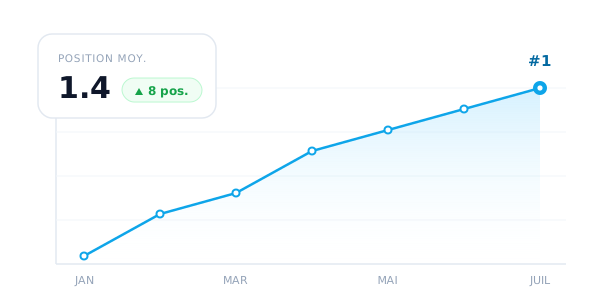
The timeline depends on a few factors: how technically healthy the site already is, how competitive your keywords are, the strength of your existing authority, and how consistently new content and links are added. Quick wins, such as fixing indexing problems or optimizing pages that already rank on page two, can move the needle in weeks. Competitive head terms and authority building take longer because trust is earned, not bought. The compounding nature is the point: the work you do this quarter keeps paying off long after it is finished, which is what makes the channel so cost-effective once it matures.
GEO and AI search: being cited by AI
Search is no longer only blue links. Google AI Overviews, ChatGPT, Perplexity, and similar tools increasingly answer questions directly, often citing a handful of sources. Generative Engine Optimization, or GEO, is the practice of making your content the source these systems quote.
The encouraging news is that GEO rests on the same foundations as good SEO, extended for machine reading. To be cited, content should :
- Answer questions directly and early, so an AI can lift a clean, self-contained passage.
- Be well structured, with clear headings, lists, and tables that map to specific questions.
- State facts plainly and back them with context, since AI systems favor sources that read as authoritative and unambiguous.
- Use structured data so machines can parse what your pages describe.
- Remain accessible to AI crawlers such as GPTBot, ClaudeBot, and PerplexityBot, rather than blocking them.
We build pages that earn both classic rankings and AI citations, because the businesses that get quoted by these tools today are positioning themselves for how a growing share of people will search tomorrow.
Common SEO mistakes to avoid
We see the same avoidable errors hold back otherwise strong businesses.
- Ignoring mobile and speed. In a mobile-first market, a slow or clumsy mobile experience quietly costs rankings and sales every day.
- Targeting the wrong language. Optimizing only in English, or only in French, when your audience searches in both, leaves traffic on the table.
- Thin or duplicated content. Pages that say little, or repeat each other, give Google no reason to rank them and nothing for AI tools to cite.
- Buying spammy backlinks. Cheap, irrelevant links can trigger penalties that are slow and painful to recover from. Authority must be earned.
- Neglecting the Google Business Profile. For any local business, an incomplete or inconsistent profile means missing the map pack entirely.
- Expecting overnight results. Treating SEO as a one-month campaign rather than an ongoing investment leads to abandoning it just before it pays off.
Who SEO is for
SEO is for any business in or selling to Morocco that wants qualified traffic it does not have to rent. It is for the e-commerce founder tired of rising ad costs, the riad owner who wants international guests to find them directly, the exporter who wants European buyers to discover their products, and the local service provider who wants to own their city’s searches. If your customers use Google, and in Morocco they overwhelmingly do, then SEO is the channel that meets them at the moment of intent and keeps doing so long after the work is done.
If that sounds like your business, the next step is simple: review how we work on the home page, see what an engagement looks like on our pricing page, and tell us about your goals through the contact page. We will start with an audit, show you where the opportunities are, and build a plan that turns Moroccan and international search demand into measurable growth.