A patient with a toothache in Casablanca does not open the phone book. She opens Google. So does the father searching for a pediatrician near his neighborhood in Rabat, the company arranging annual checkups for its staff, the expat in Marrakech looking for an English-speaking general practitioner, and the patient in Lyon comparing Moroccan dental clinics for an implant he cannot afford at home. Every day, in every city in Morocco, thousands of people search for care, and the clinics, dental practices, laboratories, and medical centers that appear first receive the calls. As an SEO agency working with healthcare providers in Morocco, our job is to make sure the provider they find is you.
This page explains how patients actually search for healthcare, why the Google Business Profile is the single most important local asset a practice owns, why Google holds medical content to a higher standard than any other category, and how we handle local visibility, reviews, multilingual patients, and appointment conversion. It is written for practice owners, clinic directors, and lab managers who already deliver good care and now want the patients searching for it to find them.
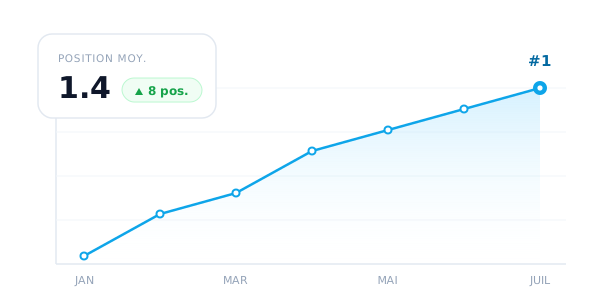
Why clinics, labs, and medical practices in Morocco need SEO
Answer first: patients choose providers through Google before they ever call, and the practice that ranks captures the appointment without paying for every click. SEO turns the constant stream of health searches in your city into a durable flow of booked patients.
Healthcare demand is unlike demand in any other sector: it is urgent, local, and trust-driven. A patient searching for a dentist open on Saturday or a laboratory that does a specific blood panel is not browsing. She intends to act today, usually within a few kilometers of where she is standing. Our own research confirms how concentrated that opportunity is: in our Morocco SEO study, built on 794,000 real impressions, page 1 of Google captured 96 percent of all clicks. A practice on page 2 is, for practical purposes, invisible.
The providers that benefit most from healthcare SEO in Morocco include:
- Dental practices. Dentistry is the most searched and most competitive medical vertical in Moroccan local search. Rankings for the core dental queries in a city translate directly into new patient calls.
- Multi-specialty clinics and medical centers. Each specialty is its own search battle. A clinic with cardiology, gynecology, pediatrics, and radiology needs a dedicated, well-built page for each, or it concedes those searches to single-specialty competitors.
- Medical laboratories. Patients search for specific analyses, panels, and checkup packages, plus practical details like hours, locations, and whether results are available online. Labs with multiple collection points need location-level visibility for every site.
- General practitioners and specialists. Individual practitioners are searched by name, by specialty, and by neighborhood. Owning those three query types is the foundation of a full agenda.
- Health platforms and booking services. Platforms that aggregate practitioners live and die by programmatic local rankings across hundreds of specialty and city combinations.
For all of them, organic search is the channel that keeps producing after the ad budget stops. You can see how this fits our broader methodology on our SEO service page.
How patients search: symptom, practitioner, and near me queries
Answer first: healthcare searches fall into three layers, symptom queries, practitioner and treatment queries, and near me queries, and each layer needs a different type of page. Most practices only compete in one layer and wonder why growth stalls.
Symptom queries come earliest in the patient journey. Someone searches for the cause of a persistent cough, tooth pain when drinking something cold, or what a particular blood test result means. These searches are informational, high in volume, and dominated by health portals, but a local practice that answers them credibly earns two things: early trust with patients who will soon need care, and the topical authority that helps its commercial pages rank. These queries happen overwhelmingly in French, with Arabic growing fast, especially on mobile.
Practitioner and treatment queries are the commercial core. Patients search for a dentist, a cardiologist, or a pediatrician in their city, for a specific treatment like dental implants or a cardiac checkup, or for a practitioner they were referred to by name. Intent is high and the click usually goes to a provider, not a portal. Every specialty and every major treatment you offer deserves its own page, built around how patients actually phrase the search, not around internal medical taxonomy.
Near me and practical queries are the most urgent layer: laboratory near me, dentist open now, clinic with weekend hours, radiology center in a specific neighborhood. These searches are resolved almost entirely in the map results, which means they are won or lost on the strength of your Google Business Profile, your reviews, and the consistency of your location data. A large share of them convert within the hour.
One more pattern matters in Morocco: patients frequently search in French but speak Arabic on the phone, and a growing minority search in Arabic end to end. The keyword map has to reflect the languages patients search in, per query type, not the language the practice prefers.
Google Business Profile: the number one local factor for practices
Answer first: for a medical practice, the Google Business Profile is the single highest-leverage asset in local search. It decides who appears in the map results where near me and practitioner searches are resolved, and most Moroccan practices run theirs at a fraction of its potential.
When a patient searches for a dentist or a laboratory in her city, Google shows a map with three providers before any website. Placement in that pack depends on relevance, proximity, and prominence, and every one of those can be worked on:
- Complete, accurate categories. The primary and secondary categories must match what patients search for. A medical center listed under one generic category loses every specialty-level map search it could have won.
- Services, descriptions, and attributes. Listing the actual consultations, treatments, and analyses you offer, in the language patients use, gives Google the relevance signals it needs.
- Photos of the real practice. Genuine photos of reception, rooms, and equipment measurably increase calls and direction requests, because patients are choosing a place they will physically visit.
- Hours, phone, and holiday updates. Wrong hours during Ramadan or holidays produce missed calls and angry reviews. We keep this data current as a standing task.
- Posts and Q&A. Regular updates and answered questions keep the profile active and give patients answers before they have to call.
- One profile per location, correctly structured. Clinics with several sites and labs with multiple collection points need a properly built profile for each location, plus practitioner profiles where individual doctors are searched by name.
The profile does not work alone. It links to the website, and Google cross-checks both. Which is why the next two sections, content quality and local pages, decide whether profile visibility turns into rankings everywhere else.
E-E-A-T and YMYL: why Google holds medical content to a higher standard
Answer first: Google classifies health content as Your Money or Your Life and evaluates it for experience, expertise, authoritativeness, and trustworthiness. Medical pages written by no one, citing nothing, signed by nobody, do not rank, no matter how well they are optimized.
This is the defining difference between healthcare SEO and every other vertical. Because bad medical information can hurt people, Google’s systems and its human quality raters apply a stricter standard to health pages. In practice, that standard rewards a specific set of signals:
- Real practitioners behind the content. Every medical page should be written or reviewed by a named clinician, with a visible byline or reviewer credit. Anonymous health content is a liability.
- Credentials on display. Practitioner pages with diplomas, specializations, professional registrations, and years of practice. These pages do double duty: they satisfy Google’s expertise signals and they are what patients read before deciding to book.
- Accurate, sourced claims. Statements about conditions, treatments, and outcomes should be consistent with established medical consensus and sourced where appropriate. We never publish exaggerated treatment claims, and Moroccan regulations on medical advertising make restraint a legal matter as well as a ranking one.
- Trust infrastructure. A secure site, a real address matching the Google Business Profile, clear contact details, practitioner names in the footer and legal pages, and a privacy policy that covers patient data.
- Consistency across the web. The practice’s name, address, and phone number identical everywhere they appear, and practitioners’ profiles on professional directories aligned with the site.
For practices, this is good news disguised as a burden. You already have what Google is looking for: real doctors, real credentials, real clinical experience. Most competitors never put those assets on the page. We structure the site so your genuine expertise is visible to both patients and search engines, which is the most durable ranking advantage a medical site can have.
Local SEO by city and neighborhood
Answer first: healthcare is chosen locally, so the site must be structured around locations as much as around services. Practices with one site need neighborhood-level relevance; groups and labs with multiple locations need a dedicated, genuinely useful page per location.
Patients rarely search for a dentist in Morocco. They search for a dentist in Casablanca, in Rabat Agdal, in Marrakech Gueliz, or simply near me. Winning those searches takes more than mentioning the city in a title tag:
- Location pages that earn their existence. Each clinic, cabinet, or collection point gets a page with its own address, embedded map, photos, practitioners, hours, parking and transport notes, and the services offered at that specific site. Thin, duplicated city pages are a known failure pattern in healthcare, and Google filters them out.
- Service and location intersections. Where real search volume exists for a specialty in a specific city, we build for it deliberately rather than hoping a generic page ranks everywhere.
- Neighborhood signals. Mentioning the districts you actually serve, the landmarks patients use to find you, and the areas your patients come from builds relevance for the micro-local searches that map results feed on.
- Local citations and directories. Consistent listings on the directories and health platforms that matter in Morocco reinforce the location data Google already has.
This is the same playbook behind the parapharmacy case on our results page, where structured local work took one brand to page 1 in five cities. Healthcare local SEO follows the same mechanics with a higher bar for content quality, and the compounding is identical: every location page that ranks becomes an appointment source that costs nothing per click.
Reputation and reviews: the trust layer
Answer first: reviews are both a ranking factor in the map results and the deciding factor in the patient’s mind. A practice with a systematic, ethical review process outranks and outconverts an identical practice that leaves reviews to chance.
Patients trust other patients. Before booking, almost everyone reads the reviews, and a 4.8 with 200 reviews beats a 4.9 with 11, because volume signals reliability. Reviews also feed the prominence component of local rankings, which means reputation work is ranking work. Our approach:
- A consistent ask. The reliable moment to request a review is shortly after a positive visit, through a direct link sent by the front desk or by message. We build this into the practice’s routine so review flow is steady, not a one-time campaign.
- Responses to everything. Every review gets a reply. Positive reviews get a brief, warm thank you. Negative reviews get a calm, professional response that never discusses the patient’s condition or details, because confidentiality applies in public replies just as it does in the consultation room.
- No fakes, ever. Purchased or fabricated reviews are detectable, against Google’s policies, and uniquely damaging for a medical brand. One exposed fake review costs more trust than fifty real ones build.
- Learning from the pattern. Recurring complaints about waiting times or phone responsiveness are operational data. The practices that fix the cause, not just the review, watch their ratings climb on their own.
Multilingual patients: French, Arabic, and English
Answer first: Moroccan healthcare search is French-first, Arabic is growing quickly, and English opens the door to expats and international patients. The site should be structured so each language version is complete and indexable, not a partial translation bolted on.
French carries the majority of medical search volume in Morocco today and is the natural base layer for any practice site. But treating French as the only language leaves two growing audiences on the table.
Arabic search is expanding year over year, driven by mobile usage, and it skews toward symptom and condition queries. Arabic content is also dramatically less competitive: the practice that publishes credible medical content in Arabic often ranks quickly because so few competitors bother. For practices serving a broad local population, an Arabic version of core service pages is one of the highest-return investments available.
English serves two audiences. The first is the resident expat community in Casablanca, Rabat, Marrakech, and Tangier, which actively searches for English-speaking doctors and dentists. The second is medical tourism. Patients in France, the UK, Spain, and West Africa compare Moroccan clinics for dental implants, orthodontics, fertility treatment, eye surgery, and comprehensive health checkups, where quality is high and costs are a fraction of European prices. Winning these patients takes English and French pages that answer what an international patient actually worries about: practitioner credentials and accreditation, transparent pricing, how the visit is organized, aftercare, and follow-up once they return home.
Technically, this means proper hreflang implementation, fully translated pages rather than fragments, and language-consistent Google Business Profile data. Strategically, it means measuring real query volume per language for your specialty before deciding what to build, which is exactly how we start.
Appointment-conversion pages: from ranking to booked patient
Answer first: a ranking only matters if the visit becomes an appointment. Healthcare pages convert when they remove the patient’s uncertainty, about the practitioner, the process, and the price range, and make contacting the practice effortless on a phone.
Most medical sites in Morocco lose patients after the click. The page ranks, the patient lands, and then finds no practitioner names, no reassurance, and a contact page with a single unmonitored form. We build every service page to a conversion standard:
- Answer the fear first. Patients arrive anxious. The page should state clearly what the consultation or treatment involves, how long it takes, whether it hurts, and what happens next, in plain language a non-medical reader understands.
- Show the humans. The treating practitioners, with photos and credentials, linked to their full profiles. Patients book people, not buildings.
- Practical details up front. Hours, address, map, parking, insurance and mutuelle information, and what to bring. Every unanswered practical question is a phone call the front desk has to absorb or a patient who books elsewhere.
- A tap-to-call button and a booking path. The majority of healthcare traffic is mobile, and the phone remains the dominant booking channel in Morocco. A visible click-to-call button, WhatsApp where the practice uses it, and an online booking option where available.
- Honest expectations. No miracle promises, no before-and-after exaggeration. Restraint converts better with patients and keeps the practice on the right side of medical advertising rules.
Measurement: what we track and report
Answer first: healthcare SEO should be measured in patient actions, calls, direction requests, form and booking completions, not in traffic alone. We report the numbers a practice owner actually cares about, monthly, in plain language.
Rankings and traffic are inputs. The outputs we track:
- Calls from search. Google Business Profile call tracking plus click-to-call events on the site, so you know how many phone contacts search generated.
- Direction requests and map actions. The clearest signal that a nearby patient chose you.
- Bookings and form submissions. Where online booking exists, completed appointments attributed to organic search.
- Visibility per service and city. Ranking positions for the treatment, specialty, and location queries that map to revenue, not vanity keywords.
- Review velocity and rating. Volume, average, and response rate over time.
Everything we publish about our own performance follows the same standard: the case studies on our results page are verifiable, not decorative. We would rather show you a smaller true number than a large vague one.
Common healthcare SEO mistakes to avoid
We see the same errors hold back otherwise excellent practices:
- Anonymous medical content. Pages with no author, no reviewer, and no credentials, which Google’s health-specific standards quietly filter out of the results.
- A neglected Google Business Profile. Wrong hours, generic categories, no photos, unanswered reviews. The most valuable local asset treated as a formality.
- One page for everything. A single services page trying to rank for ten specialties, instead of a dedicated, well-built page per specialty and treatment.
- Copied or machine-translated content. Duplicate text across pages or locations, and Arabic or English versions that read like translations. Both fail patients and rankings.
- Ignoring Arabic. Conceding the fastest-growing language segment to whichever competitor moves first.
- Buying reviews or links. Shortcuts that are detectable, penalizable, and uniquely damaging to a brand whose entire value is trust.
- No measurement. Running SEO for a year without call tracking or booking attribution, so nobody knows what worked.
How we work
We run healthcare SEO as a clear, repeatable process, so you always know what is happening and why.
- Audit. Technical health, indexing, speed, mobile experience, current rankings, Google Business Profile state, review profile, and a competitor read for your specialty and city.
- Patient search map. The symptom, treatment, practitioner, and near me queries your patients make, per language and per location, matched to the pages that should answer them.
- Foundation fixes. Technical corrections, site structure, location pages, practitioner profiles, and the trust infrastructure Google expects from a medical site.
- Content with your clinicians. Service and condition pages drafted with input from your practitioners and signed by them, in French first, then Arabic and English where the demand justifies it.
- Profile and reputation. Google Business Profile optimization for every location, a sustainable review process, and response handling that respects patient confidentiality.
- Reporting. Monthly, in plain language: calls, direction requests, bookings, rankings, and what we are doing next.
Who it is for
Healthcare SEO is for any provider in Morocco that wants its agenda filled by patients who searched and chose, rather than rented attention: the dental practice competing in the toughest local vertical, the multi-specialty clinic whose specialties each deserve their own visibility, the laboratory with collection points across a city, the general practitioner building a patient base in a new neighborhood, and the medical center ready to welcome international patients for dental work, checkups, and planned treatments.
The demand already exists. Patients in your city are searching right now, and page 1 is taking 96 percent of their clicks. Review our methodology on the SEO service page, verify what we have done for other clients on the results page, and tell us about your practice through the contact page. We will start with an audit, show you exactly where the patients you are missing go today, and build the plan that brings them to you instead.