Software is one of the few products where your best customers start searching long before they know your category exists. An HR manager in Casablanca does not wake up and type the name of your product. She types a question about payroll compliance, or leave tracking, or how to stop managing attendance in Excel. Months later she compares three vendors and picks one. SaaS SEO is the discipline of being present at every step of that journey, from the first vague question to the final pricing comparison, so that when the decision comes, your product is the one she already trusts.
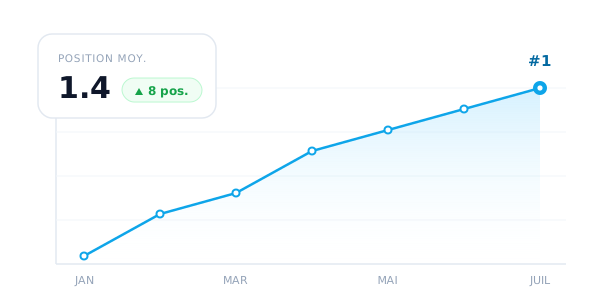
We know this works in Morocco because we have done it for ourselves. We operate a Moroccan HR SaaS that we grew to 1.6 million Google impressions with the exact playbook on this page, and it ranks number one on its highest-intent HR query. The full numbers are on our results page. This page explains why SaaS search behaves differently from every other kind of search, how the content hub model captures buyers before your competitors know they exist, why we build bottom-funnel pages first, and how we measure everything against signups rather than traffic. It is written for founders and marketing leads who sell B2B software from Morocco, to Morocco, or to the world.
Why SaaS SEO is a different discipline
Answer first: SaaS buying cycles are long, deliberate, and research-heavy, so SaaS SEO must cover an entire journey of queries rather than a single high-intent search. The company that answers the buyer’s questions at every stage wins the evaluation before it formally begins.
Compare it to local or e-commerce search. Someone searching for a restaurant or a leather bag decides within minutes. A B2B software buyer researches for weeks, involves colleagues, builds shortlists, and returns to Google a dozen times with progressively sharper queries. Each of those queries is a distinct opportunity, and they fall into three broad stages :
- Problem-aware queries. The buyer knows the pain but not the solution category. How to track employee leave, why is our invoicing always late, how to manage field teams remotely. Highest volume, earliest in the journey, and almost always ignored by competitors who only optimize their product pages.
- Solution-aware queries. The buyer has named the category and is exploring it. HR software Morocco, best invoicing tool for small business, CRM for real estate agencies. Moderate volume, strong intent, competitive.
- Comparison and decision queries. The buyer is choosing. Product A vs product B, alternatives to X, X pricing, does X integrate with Y. Low volume, extremely high intent, and worth more per click than anything else you can rank for.
Most SaaS companies in Morocco have a homepage, a features page, and a blog with three abandoned posts. That footprint captures a sliver of stage two and nothing else. The whole opportunity is in covering all three stages deliberately, and doing it before your competitors do, because in B2B software the first vendor a buyer learns from tends to frame how they judge everyone else.
There is one more structural reason SEO suits SaaS unusually well: unit economics. A ranked page costs the same whether it brings you one customer or one hundred, and a SaaS customer pays you every month. A page that produces even two signups a month, compounding against a recurring revenue model, out-earns almost any paid channel over a two-year horizon. Our broader approach to this is on our SEO service page.
Bottom-funnel first: the pages we build before anything else
Answer first: we always ship decision-stage pages first, because they rank faster, convert hardest, and prove ROI within weeks rather than months. Blogging before your comparison and pricing pages exist is building the top of a funnel that leaks at the bottom.
The temptation in content marketing is to start with the big educational articles. We do the opposite. The first pages we build for any SaaS client are the ones a buyer reads in the final week before choosing :
- Comparison pages. Your product versus each named competitor, honestly written. Buyers search these queries constantly, the search volume is small enough that big players ignore them, and the reader is days from a decision. An honest page that concedes where a rival is stronger earns more trust, and more conversions, than a fake shootout.
- Alternative pages. Alternatives to the market leader, alternatives to the legacy tool your buyers are escaping. Whoever ranks for “alternative to X” gets introduced to every customer X disappoints.
- Pricing content. Buyers search for your pricing and your competitors’ pricing whether or not you publish it. A clear pricing page, plus content explaining what the category costs and why, captures those searches and pre-qualifies your leads.
- Integration pages. One page per tool your product connects to. Does X work with Sage, X and WhatsApp integration, connect X to your bank. Each page targets a tiny query with near-perfect intent, and together they form a wide net for buyers whose stack is non-negotiable.
- Use-case and industry pages. Your product for accounting firms, for clinics, for logistics. These match the way B2B buyers actually search, which is almost always through the lens of their own industry.
These pages share a profile: low competition, modest volume, brutal intent. They start ranking in weeks because few Moroccan SaaS companies bother to build them, and every visit is a buyer in motion. Only once this layer exists do we scale the top of the funnel, because now every reader the hub attracts has somewhere high-converting to land.
The content hub: own the questions your buyers ask first
Answer first: a content hub is a structured library that answers every meaningful question your buyers ask across the entire journey, organized around topics rather than keywords, and interlinked so authority flows to the pages that convert. It is how you reach buyers before they know your product exists, and it is the single biggest lever in SaaS SEO.
Here is the logic. For every buyer searching your category name today, there are ten searching the problems your category solves. They do not know the vocabulary yet. They are asking how to calculate overtime correctly, how to stop chasing unpaid invoices, how to onboard remote employees. If your content is the answer they find, you become their teacher, and buyers overwhelmingly shortlist their teachers.
A hub is not a blog. A blog is a chronological stream of whatever the team felt like writing. A hub is an engineered structure :
- Pillar pages cover a core topic completely, such as the complete guide to payroll in Morocco, and target the broad head term.
- Cluster articles each answer one specific question in depth and link up to the pillar, targeting the long tail.
- Internal links run in both directions, so every article strengthens the pillar and the pillar distributes authority back down. Conversion paths from every article lead to the relevant bottom-funnel page or to a signup.
This structure tells Google you have topical authority, which lifts the ranking of every page in the cluster, including the commercial ones. It also feeds AI search engines clean, citable answers, which matters more every quarter as buyers ask ChatGPT and Gemini the questions they used to type into Google.
This is precisely how we grew our own HR SaaS. We mapped every question a Moroccan HR manager asks, from labor law basics to leave calculations, wrote the best answer in French for each, and linked the whole hub into the product’s signup flow. The result is 1.6 million impressions, a number one ranking on the highest-intent query in the space, and a steady stream of signups from people who arrived with a question and left with an account. The receipts are on our results page.
Product-led content: the article is the demo
Answer first: the strongest SaaS content does not just answer the question, it answers it using your product, so the reader learns the solution and sees your software solving it in the same read. This converts far better than generic advice with a banner at the end.
Generic content says here are five ways to track employee attendance. Product-led content says here is how to track attendance, and walks through the workflow inside your product with real screenshots, so by the end the reader has effectively watched a demo without booking one. The article ranks for the informational query, and it sells while it educates.
We apply this wherever it is honest to do so :
- Workflow tutorials. Step-by-step guides to solving the searched problem inside your product, with screenshots and realistic data.
- Templates and calculators. A payroll calculator, an invoice template, a leave-balance spreadsheet. These rank, earn links, and hand you a natural upgrade path: the template is free, the automation is the product.
- Data content. You sit on anonymized usage data no journalist has. Publishing benchmarks from it earns backlinks that money cannot buy and positions you as the reference in your category.
Product-led content only works if the product genuinely solves the searched problem, which is why we write from inside the product rather than outsourcing to writers who have never logged in.
French first, English for the world
Answer first: the Moroccan and francophone African B2B market searches in French, and it is dramatically less competitive than the English-speaking market, so a Moroccan SaaS should usually win in French first and build English content as the expansion engine.
This ordering is a genuine structural advantage. In English, every SaaS keyword is contested by venture-funded content teams publishing daily. In French, and especially in French with a Moroccan or African business context, whole categories of buyer questions have no good answer online at all. A Moroccan SaaS that answers them properly can take the top position and hold it, exactly as our HR product did on its core query.
The practical shape of the work :
- French content hub for Morocco and francophone Africa. Written for the regulatory and business reality of these markets, not translated from generic French-of-France content. Local specificity is a ranking and trust advantage no foreign competitor can fake.
- English hub for international expansion. Targeted at the niches where you can win, which usually means the same industry and use-case angles rather than head-on assaults on broad terms.
- Clean multilingual architecture. Separate URL paths per language with correct hreflang, so Google serves each market the right version and neither language cannibalizes the other.
One behavioral fact shapes all of this: B2B search is a desktop activity. Our Morocco SEO study, built on 794,000 real impressions, found that business and B2B queries in Morocco stay 56 to 77 percent desktop, the inverse of consumer search. Your buyers are researching at work, on a large screen, often with colleagues. That means dense comparison tables, detailed documentation, and screenshot-heavy tutorials perform well, and it means the desktop experience of your site deserves at least as much care as the mobile one. The same study found that page 1 captures 96 percent of clicks, which is the entire argument for doing this properly: in B2B search, position is nearly winner-take-all.
Technical SEO for JS-heavy apps and modern stacks
Answer first: most SaaS websites are built on JavaScript frameworks, and rendering mistakes on these stacks can leave entire sections of a site invisible to Google. The fix is server-side rendering or static generation for everything you want indexed, plus a clean separation between the marketing site and the app.
SaaS teams build websites the way they build products, with React, Vue, or similar frameworks, and that creates failure modes ordinary businesses never face. If your pages render their content in the browser only, Google may index an empty shell, index it late, or skip it. We see Moroccan SaaS companies with excellent content earning nothing because the content technically is not there when the crawler arrives.
Our technical checklist for SaaS :
- Server-side rendering or static generation for every marketing, hub, and bottom-funnel page, so the full content is in the initial HTML response.
- App and site separation. The application behind login has no business in the index. We keep the marketing site crawlable and fast, gate the app cleanly, and make sure login walls and redirects never trap the crawler.
- Indexation control at scale. Integration and use-case pages are built from templates, and templated pages can multiply into thin duplicates if unmanaged. We control what gets indexed so every URL in the index earns its place.
- Core Web Vitals on desktop and mobile. Speed still gates rankings, and the marketing site should never pay the performance cost of the app bundle.
- Structured data. Software application, FAQ, and article schema so results show rich detail and feed AI answers correctly.
None of this is glamorous, and all of it is a prerequisite. The best content hub in Morocco earns nothing from inside a rendering problem.
Measured in signups, not traffic
Answer first: traffic is an input, revenue is the output, and SaaS SEO must be reported in the currency the business runs on: signups, demos, activations, and pipeline. If your SEO report ends at sessions and rankings, you cannot tell whether the channel works.
SaaS gives SEO an unusual gift: the conversion event is digital, immediate, and trackable. A signup or a demo request happens on the site, in the same session or a later one, and modern analytics can attribute it to the page that started the journey. So there is no excuse for vanity reporting. We wire measurement so that every content investment answers a business question :
- Page-level conversion. Which hub articles, comparisons, and integration pages actually produce signups, so the content plan doubles down on what converts rather than what merely ranks.
- Assisted journeys. B2B buyers touch many pages over weeks. We track the full path, because the problem-aware article that starts a journey deserves credit even when the signup happens on the pricing page a month later.
- Funnel stage yield. Signups per thousand visits by funnel stage, so we know the real exchange rate between top-funnel reach and bottom-funnel conversion and invest accordingly.
- Quality, not just quantity. Trials that activate and demos that show up matter more than raw form fills. We close the loop with your CRM wherever possible.
This is also how we run our own product, which keeps us honest. Impressions made a nice milestone at 1.6 million, but the metric that pays the bills is signups from search, and that is the number this entire system is designed to move.
SEO vs paid acquisition for SaaS
Answer first: paid ads deliver volume on demand and are the right tool for testing messages and covering the months while SEO matures, while SEO builds a compounding asset that keeps lowering your blended acquisition cost. Mature SaaS companies run both, and shift weight toward organic as it compounds.
| Factor | SEO (content hub and bottom-funnel pages) | Paid (Google Ads, LinkedIn) |
|---|---|---|
| Time to results | Weeks for bottom-funnel, months for the hub | Immediate |
| Cost per signup over time | Falls as content compounds | Rises with competition and CPC inflation |
| Durability | Pages keep converting for years | Stops the day spend stops |
| Reach into early-stage buyers | Excellent, owns problem-aware queries | Poor economics on informational intent |
| Best use | Durable demand capture, category authority | Launches, message testing, gap coverage |
| Compounding | Yes, every page lifts the next | No, every lead is bought at full price |
The honest takeaway: if you need signups this month, ads are the answer. If you want your acquisition cost to fall every quarter for the next three years, SEO is the answer, and the earlier you start, the sooner the compounding begins. We help clients sequence both. Talk it through on our contact page.
Common SaaS SEO mistakes we fix
The same errors appear in almost every Moroccan SaaS site we audit.
- Blogging without a bottom. Publishing educational articles with no comparison, alternative, or integration pages for readers to convert on.
- Chasing head terms only. Fighting for the category keyword while ignoring hundreds of long-tail questions that are easier to win and closer to money.
- English-only content in a French market. Copying playbooks written for the US market and leaving the far more winnable French demand untouched.
- Client-side rendering of marketing pages. Content Google cannot reliably see, on a stack chosen for the app rather than the site.
- Translated rather than localized content. French pages that ignore Moroccan regulation, pricing norms, and business reality, which buyers detect instantly.
- Reporting traffic instead of signups. Celebrating sessions while nobody can say which pages produce customers.
- Treating SEO as a campaign. Publishing for three months, seeing modest results, and quitting exactly when the compounding was about to start.
How we work
We run SaaS SEO as a repeatable system, the same one we use on our own product.
- Audit and intent map. Technical audit of your site and app rendering, then a full keyword map sorted by funnel stage and language, with the revenue-nearest queries flagged.
- Bottom-funnel build. Comparison, alternative, pricing, integration, and use-case pages shipped first, so conversions start while the hub grows.
- Hub architecture and production. Pillar and cluster structure designed around your buyers’ real questions, produced French-first or English-first depending on your market, and written from inside the product.
- Technical implementation. Rendering, indexation control, hreflang, speed, and structured data fixed on your actual stack.
- Measurement. Analytics wired to signups, demos, and activation, with CRM closure wherever possible.
- Reporting and iteration. Plain-language reporting on signups from search, with the content plan re-weighted every month toward what converts.
Who it is for
SaaS SEO is for any software company operating from or selling into Morocco that wants a customer acquisition channel it owns. It is for the funded startup that needs acquisition costs to fall as it scales, the bootstrapped product that cannot outspend competitors on ads and must out-teach them instead, the established B2B vendor whose category is being searched every day by buyers it never meets, and the Moroccan SaaS expanding into francophone Africa or the international English market. Early-stage teams often pair this with the groundwork on our SEO for startups page, while established products go straight to the hub and bottom-funnel build.
Your buyers are searching right now, in French and in English, mostly on desktop, and 96 percent of their clicks go to page 1. We have run this exact playbook on our own Moroccan SaaS to 1.6 million impressions and a number one ranking, and we publish the evidence on our results page. Read the data behind our approach in the Morocco SEO study, see how we run engagements on our SEO service page, and tell us about your product through the contact page. We will map your funnel, show you the queries you should already be winning, and build the system that turns search into signups.