Startups live or die on the cost and durability of customer acquisition. Paid channels can buy you a launch spike, but the moment the budget pauses, the traffic stops. Search engine optimisation works the other way around: every page you publish and every link you earn keeps working while you sleep, and the asset compounds instead of resetting to zero. For a startup in Morocco competing for attention, funding, and a foothold in a fast-moving market, building organic visibility early is one of the few growth levers that gets cheaper per user over time rather than more expensive.
This page is written for founders and early growth leads who want SEO to behave like an owned acquisition channel, not a vanity project. It covers why search matters specifically for startups, how to build organic growth before and while you raise, the difference between content-led and product-led SEO, the technical foundations a new product needs, how to choose topics for a brand nobody has heard of yet, the nuances between SaaS, marketplace, and app startups, how to scale into topical authority, how to get cited by AI tools, and how to measure all of it as a real growth channel against CAC and payback.
Why SEO matters for startups in Morocco
The short answer: SEO is the acquisition channel that compounds, and compounding is the closest thing a startup has to leverage on a small budget.
Most Moroccan startups start with the same problem. They have a product, limited cash, and a market that does not yet know they exist. The default reflex is to buy reach with ads. That works to validate demand, but it has three structural weaknesses for an early company:
- It stops the instant you stop paying. There is no residual value. Last month’s ad spend does not help this month.
- It gets more expensive as you scale. Auction-based channels punish you with rising costs per acquisition as you push for more volume.
- It teaches you little that lasts. A click from an ad rarely builds the brand entity, the content library, or the trust signals that make future acquisition cheaper.
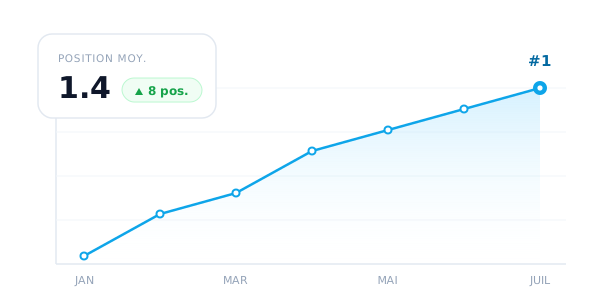
Organic search flips each of those. A page that ranks keeps delivering visitors for months or years. The cost per acquisition tends to fall as the asset matures. And the work itself (understanding what your buyers search for, answering it credibly, structuring your site so engines understand it) compounds into a durable moat that competitors cannot copy by simply outbidding you.
For Morocco specifically, there are local advantages worth naming. Search competition in many Moroccan niches is still thinner than in saturated Western markets, which means a focused startup can claim category-defining queries before incumbents wake up. The market is genuinely multilingual, so a team that understands when buyers search in French, Arabic, or English can capture demand that monolingual competitors miss entirely. And buyer trust is hard-won here, which favours brands that show up consistently in search with genuinely useful content rather than only in paid placements.
Building organic growth before and while you raise
Investors fund traction and defensibility. An organic channel that is already pulling qualified users, with a cost curve that improves over time, is exactly the kind of evidence that strengthens a raise.
There is a sequencing argument that matters here. If you wait until after a round to start SEO, you spend the months of highest cash availability building an asset that only begins to pay off a quarter or two later. If instead you lay the foundation early and let it mature in the background, by the time you are pitching you can point to a channel that already works and only needs fuel to scale. That story is far more convincing than “we plan to do content marketing.”
Practical priorities at each stage:
- Pre-seed / pre-launch. Get the technical foundation right and publish a small set of pages around the core problem you solve. Do not build a content factory yet; your positioning is still moving. Aim for a credible base that engines can index and that captures the few highest-intent searches your earliest users would make.
- Seed / early traction. Begin building topical depth around your category. Start earning links through launches, partnerships, and genuinely useful resources. Establish the brand as an entity (consistent name, clear about page, structured data) so search engines and AI tools understand who you are.
- Series A and beyond / while scaling. Now you can scale content velocity, expand into adjacent topic clusters, and treat SEO as a measurable growth channel with its own targets. The foundation you laid earlier is what makes this scaling efficient rather than a cold start.
The point is not to over-invest before you have signal. It is to make sure that the cheap, durable work happens early so the channel is already compounding when you have the resources to pour fuel on it.
Content-led versus product-led SEO
Most startups need both, but they serve different jobs and you should be deliberate about the mix.
Content-led SEO means ranking for the questions, problems, and comparisons your buyers search before they are ready to commit. Guides, how-tos, category explainers, comparison pages, and use-case content sit here. This is how you reach people at the top and middle of the journey, build authority, and feed AI assistants the material they cite.
Product-led SEO means turning the product itself, or programmatic pages derived from it, into the thing that ranks. Think of a tool that generates a page per city, per use case, per integration, or per template. A marketplace ranking for “[category] in [city].” A SaaS ranking for “[job] template” because it actually offers those templates. Here the product surface area becomes the SEO surface area, and it can scale to thousands of pages that each capture a sliver of long-tail demand.
How to think about the mix:
- If your value proposition is a library, directory, marketplace, or generator, product-led SEO is often your biggest long-term engine, because the inventory scales the content for you.
- If your value proposition is expertise, a new category, or a complex B2B sale, content-led SEO usually comes first, because you have to educate the market before product pages convert.
- Most durable startup SEO programs run content-led for authority and demand, product-led for scale, with internal links tying the two together so authority flows from your best content into your money pages.
Technical SEO foundations for a new product or site
Answer-first: get the foundation right once, early, and you rarely have to think about it again. Skip it and you cap how high anything else can climb.
A new startup site has the rare advantage of being able to do technical SEO correctly from the start, with no legacy debt. The non-negotiables:
- Crawlability and indexability. Make sure search engines can find and index the pages that matter, and that thin or duplicate pages are kept out of the index. A clean
robots.txt, a real XML sitemap, and sensible use of canonical tags cover most of it. - Site speed and Core Web Vitals. Early-stage sites are often built fast and ship heavy. Keep pages light, lazy-load images, and watch interaction responsiveness. Speed affects both rankings and conversion, which matters doubly when every visitor is expensive to acquire.
- Mobile-first reality. A large share of Moroccan search happens on mobile. The mobile experience is the experience as far as ranking is concerned, so design and test for it first.
- Sane information architecture. Decide early how your URL structure, navigation, and internal linking will scale. Group content into clusters around topics so authority concentrates instead of scattering.
- Structured data. Mark up your organisation, products, articles, and FAQs with schema so engines and AI tools understand your content and your brand entity. This is also one of the levers for AI citation.
- Internationalisation, if relevant. If you serve multiple languages, implement hreflang correctly from the outset. Getting this wrong later is one of the most painful retrofits in SEO.
None of this is glamorous, and that is precisely why startups skip it and pay for it later. The fix is to treat the foundation as part of building the product, not a marketing afterthought.
Keyword and topic strategy for a brand nobody knows yet
The strategic question for a new brand is not “what do we want to rank for” but “what can we realistically rank for now, that also matters to our business.” Those two have to overlap, and the overlap is your starting battlefield.
A workable approach:
- Start with problems, not features. People search for their problem long before they search for your solution category, and problem-level keywords stay relevant even as your product evolves. Map the problems your earliest users have, in their words.
- Prioritise by winnability times value. A new domain cannot fight incumbents for high-volume head terms on day one. Score opportunities by how achievable they are given your authority and how close they sit to revenue, then attack the high-achievability, high-value cluster first.
- Build clusters, not scattered posts. Pick one or two topics you can own and publish deeply around them. Ten connected pages on one theme beat thirty disconnected articles for building the topical authority that lets you climb to harder terms over time.
- Choose languages by real demand. In Morocco, decide per intent whether the search happens in French, Arabic, or English, and commit content where the demand justifies it rather than thinly translating everything.
- Reserve some pages for high-intent, bottom-funnel terms. Even pre-revenue, capture the few searches made by people ready to act (pricing, comparisons, “best [category] in Morocco”), because those convert and are often less contested than broad informational terms.
The discipline that separates startups who win at SEO from those who burn months: concentrate. Topical authority is built by going deep on a narrow set of themes, not wide on everything at once.
SaaS versus marketplace versus app: where the strategy diverges
The fundamentals are shared, but the highest-leverage tactics differ by startup type.
SaaS startups usually win on a blend of content-led authority and programmatic product pages. Educational content captures the people researching the problem; comparison and alternative pages capture people evaluating tools; integration, template, and use-case pages provide programmatic scale. The brand entity and trust signals matter a lot, because B2B buyers research extensively before they commit.
Marketplace startups live on programmatic and local SEO. Pages per category, per city, per service, and per listing are the engine, and the inventory generates the pages. The challenge is quality at scale: thin, near-duplicate pages get filtered out, so each programmatic template has to carry genuinely useful, distinct content. Local relevance and structured data are central, especially in a market where buyers search by city.
App startups add a second front: app store optimisation alongside web SEO. Web content drives discovery and feeds install pages, while the app stores have their own ranking logic around titles, descriptions, ratings, and keywords. The smart play is to use web SEO to own the problem and category searches, then route that intent into app installs, rather than relying on store search alone.
Scaling content and building topical authority
Authority is earned by depth and consistency, not by a single viral post. Once your core cluster holds, scaling is about widening your territory without diluting quality.
The mechanics of scaling well:
- Expand into adjacent clusters. When you own one topic, move to the neighbouring problem your buyers also have. Each new cluster borrows authority from the last through internal links.
- Refresh as aggressively as you publish. Updating and improving existing pages often returns more than new ones. Rankings decay; maintenance is part of the channel, not an afterthought.
- Earn links through things worth linking to. Original data, free tools, strong launches, and genuinely useful resources attract links naturally. For a Moroccan startup, local press, partnerships, and community resources are realistic, durable sources of authority.
- Tie content to money pages. Authority is only useful if it flows toward pages that convert. Internal linking from your best-read content into your product and pricing pages is what turns traffic into pipeline.
- Keep velocity sustainable. A steady cadence you can hold for a year beats a burst you abandon after a month. Engines and audiences both reward consistency.
If you want a sense of how this plays out in adjacent verticals, our work on e-commerce SEO in Morocco and SEO for small businesses in Morocco shows the same principles applied to different business models.
GEO: being cited by AI tools, not just ranked
Generative engine optimisation is the new front, and for startups it is an opportunity rather than a threat. The brands that show up in ChatGPT answers, Perplexity citations, and Google’s AI Overviews capture buyers who never scroll a traditional results page.
What earns AI citations overlaps heavily with good SEO, plus a few specifics:
- Clear, extractable structure. AI systems quote content they can parse cleanly: direct answers near the top, descriptive headings, lists, and well-marked facts. Answer-first writing is also AI-first writing.
- Genuine expertise and sources. Generative engines favour content that demonstrates real knowledge and cites credible sources. Thin, generic content rarely gets quoted.
- A coherent brand entity. Consistent naming, structured data, and an unambiguous identity help AI tools recognise and attribute your brand correctly.
- Coverage of the questions buyers actually ask. Comparison, definition, and “how do I” content is exactly what assistants synthesise, so owning those formats puts you in the answer.
For a young startup, GEO levels the field. You do not need decades of domain authority to be a clear, credible source on a focused topic, and being the cleanest answer on your niche question can get you cited well above your weight.
Measuring SEO as a growth channel: CAC and payback
Answer-first: if you cannot tie SEO to acquisition economics, you cannot defend the budget to a board, so measure it the way you measure every other channel.
The metrics that matter to a founder are not rankings for their own sake. They are:
- Organic-sourced signups, leads, or sales. Connect search traffic to actual conversions, not just sessions, so you know what the channel produces.
- Blended and channel CAC. Track the cost to acquire a customer through organic against paid. Because organic cost is largely fixed investment rather than per-click spend, its CAC tends to fall as traffic grows, while paid CAC tends to rise with scale.
- Payback period. SEO has a longer payback than paid at first, then a much better one once the asset matures. Modelling this honestly keeps expectations and runway aligned.
- Compounding rate. Watch whether organic traffic and conversions grow month over month from the same base of work. That compounding is the entire reason the channel is worth building.
The strategic framing for investors and your own planning: paid acquisition is an expense you rent; SEO is an asset you own. The table below makes the trade-off explicit.
SEO versus paid acquisition for startups
| Factor | SEO (organic) | Paid acquisition |
|---|---|---|
| Time to first results | Slower; weeks to months for a new domain | Fast; traffic the day you fund it |
| Cost behaviour as you scale | Cost per acquisition tends to fall as the asset matures | Cost per acquisition tends to rise in competitive auctions |
| Durability | Compounds; pages keep working after the work is done | Stops the moment the budget pauses |
| Trust and credibility | High; organic placement signals legitimacy | Lower; users discount ads |
| Brand and AI-citation value | Builds an entity that AI tools can cite | Builds little lasting brand asset |
| Best role for a startup | Long-term, compounding acquisition moat | Fast validation and demand spikes |
The takeaway is not “never run ads.” It is to use paid for speed and validation while you build SEO as the channel that lowers your blended CAC over time. Startups that lean only on ads stay on a treadmill where growth requires ever-rising spend.
Common startup SEO mistakes
Most of the damage is done by omission, not by doing SEO badly. The recurring ones:
- Launching with no SEO foundation. Shipping a fast-built site with broken indexability, unscalable URLs, and no structure, then trying to retrofit it after traction. This is the single most expensive mistake, because you lose both the rework cost and the months of compounding you could have banked.
- Treating SEO as a switch to flip when runway gets short. By the time cash is tight, you need results now, and SEO does not produce now. It produces for those who started before they needed it.
- Spreading content too thin. Publishing widely across unrelated topics instead of going deep on a winnable cluster, so no theme ever reaches the authority needed to rank.
- Chasing volume over intent. Ranking for big informational terms that never convert while ignoring the smaller, high-intent searches close to revenue.
- Ignoring language strategy in Morocco. Guessing whether buyers search in French, Arabic, or English instead of checking real demand, and thereby missing whole segments.
- No measurement loop. Producing content without tying it to signups, CAC, or payback, so the channel cannot be defended or optimised.
Avoiding these is largely about sequencing and discipline rather than secret tactics. Foundation first, concentration over spread, intent over volume, and measurement throughout.
How we work with startups
We work the way an early-stage team needs: focused on the few moves that compound, honest about timelines, and tied to acquisition economics rather than vanity metrics. A typical engagement runs roughly in this shape.
- Foundation and audit. We get the technical base right, fix anything blocking indexation or speed, and make sure the site can scale without rework.
- Strategy and target cluster. We map your buyers’ searches across the relevant languages, score opportunities by winnability and value, and pick the one or two clusters you will own first.
- Build and publish. We produce answer-first, genuinely useful content and the product or programmatic pages that fit your model, all interlinked so authority concentrates.
- Authority and GEO. We earn links through launches, partnerships, and resources worth citing, and structure everything so AI tools can quote you.
- Measure and scale. We connect organic to signups and CAC, then scale velocity and clusters where the economics prove out.
You can see how we package SEO work and what it costs on our pricing page, explore our broader SEO services for context, and reach out directly through our contact page to talk through your stage and market. If you want the full picture of our approach, the English overview is the place to start.
Who this is for
Startup SEO in Morocco is the right fit if you recognise yourself in most of these:
- You are pre-seed to Series A, building something with a real digital footprint, and you want acquisition that does not depend entirely on paid spend.
- You can commit to a steady cadence rather than a one-off burst, and you value a compounding asset over an instant spike.
- Your buyers research online before they commit, which means search is part of their journey whether or not you are present in it.
- You want a channel you can show investors as evidence of durable, improving unit economics.
It is a weaker fit if you need pure short-term volume this week and have no patience for a channel that pays back over quarters, or if your entire model depends on a market that genuinely does not search at all. For nearly every other startup, organic search is the acquisition channel most worth owning, because it is the one that keeps working long after the work is done.
If that sounds like your company, the next step is a conversation about your stage, your market, and the languages your buyers actually search in. Start with our contact page and we will map the first winnable cluster together.