A traveler planning a trip to Morocco rarely books on impulse. They spend days, sometimes weeks, searching Google in English: comparing the best Sahara tours, reading about which riad sits closest to the Marrakech medina, and figuring out how many days they need in Fes. The business that shows up with the clearest, most relevant answer during that research wins the booking. As a travel SEO agency in Morocco, our entire job is to make sure that business is yours, not an OTA listing that charges you a commission to send you your own customer.
This page explains why travel and tourism businesses in Morocco need search visibility, how international booking intent actually works, and how we turn organic search into direct, commission-free bookings.
Why travel businesses in Morocco need SEO
Answer first: because the booking decision is made on Google long before any money changes hands, and almost all of that searching happens in English by people who are not yet your customers. If you are invisible during that research phase, you are invisible during the decision.
Morocco is one of the most searched travel destinations in the world. Millions of international visitors arrive every year for Marrakech, the Sahara, Fes, Chefchaouen, Essaouira, the Atlas Mountains and the coast. Every one of those trips begins as a search query. The supply of tours, riads, hotels and experiences is enormous, which means the deciding factor is rarely whether your offer is good. It is whether the traveler can find your offer at the exact moment they are choosing.
Four kinds of travel business in Morocco have the most to gain from SEO:
- Tour operators and DMCs. People search for specific itineraries (“3 day desert tour from Marrakech to Merzouga”, “Morocco 10 day itinerary”). These are high-value, high-intent searches, and a single ranking page can feed bookings for years.
- Riads and hotels. Accommodation is intensely local and intensely visual. Travelers search by city, neighborhood and landmark, then check Maps and reviews before booking. This is where Google Business Profile and local SEO win or lose the booking.
- Travel agencies. Whether you build custom trips or sell packages, your competitors are one search away. Ranking for planning and booking queries keeps you in the consideration set instead of being skipped.
- Activity and experience providers. Quad biking, cooking classes, hammams, surf lessons, hot-air balloon rides, guided medina walks. These are exactly the “things to do in [city]” searches travelers run once they have booked their flights, and they convert fast.
In every one of these cases the alternative to ranking is paying. Either you pay an OTA a commission on each booking, or you pay for ads on every click. SEO is the channel where, once you rank, the traffic keeps arriving without a per-booking toll.
A note on proof: our methods are documented with real Search Console numbers on our results page, and our Morocco SEO Study 2026 quantifies what position is worth here: page 1 captures 96% of clicks, and the top 3 earns 4.3 times the clicks of positions 6 to 10. For travel brands competing on international queries, that gap is the whole game.
Capturing international travelers searching in English
The single biggest opportunity in Moroccan travel SEO is intercepting demand that already exists, in the language it is searched in. Most leisure visitors to Morocco are international, and most of them research in English even when it is not their first language. They type queries like:
- “best time to visit Morocco”
- “is Marrakech safe for tourists”
- “how many days in Fes”
- “Sahara desert tour from Marrakech reviews”
- “best riad in Chefchaouen with view”
- “things to do in Essaouira in 2 days”
These searches map onto a journey, and the journey matters because intent changes as the traveler moves through it. Early on, people are dreaming and planning. Later, they are comparing specific options. At the end, they are ready to book. A serious travel SEO strategy covers all three stages instead of only chasing the final booking query.
The travel search journey
- Dreaming and planning. “Is Morocco worth visiting”, “Morocco itinerary 7 days”, “best places to visit in Morocco”. The traveler does not know you yet. Helpful guide content earns the first contact and builds trust.
- Comparing. “Marrakech vs Fes”, “best desert tour company Morocco”, “riad or hotel in Marrakech”. Now they are weighing options. Your destination and experience pages need to be the clearest answer.
- Booking. “book Sahara tour Merzouga”, “riad medina Marrakech book direct”, “Atlas Mountains day trip price”. This is money intent. These pages must load fast, show availability, and make booking effortless.
A traveler who found your honest guide to the best time to visit the Sahara is far more likely to book your desert tour than a stranger who lands cold on a booking page. That is why planning content is not a distraction from sales. It is the top of your own funnel, and it is an asset OTAs cannot easily replicate for your specific business.
Multilingual SEO: English, French and Arabic
Answer first: most inbound tourism searches happen in English, but Morocco is genuinely trilingual, and the right language mix depends on who books your trips. Getting this wrong is one of the most common and most expensive mistakes we see.
- English is usually the priority for international leisure tourism. It is the default research language for visitors from the UK, North America, Australia and much of Europe and Asia.
- French is essential for the large French-speaking market, for many European travelers, and for a share of domestic and regional demand.
- Arabic matters for domestic travelers and visitors from across the region, and is increasingly important for that audience.
The mistake is treating “multilingual” as running pages through translation and hoping for the best. Proper multilingual SEO requires:
- hreflang tags so Google understands which language and region each page targets, and serves the correct version to each searcher.
- Native, search-aware copy in each language, because people search differently in English, French and Arabic. A literal translation of an English keyword rarely matches what a French speaker actually types.
- A clean URL structure for each language version, so the versions support each other instead of competing for the same rankings.
Done well, each language version captures its own audience and none of them cannibalize the others. Done badly, you split your authority, confuse Google, and rank for nothing. This is technical work, and it is the foundation of any travel site selling to an international audience. If you want the underlying mechanics, our main SEO services page explains how we approach technical and on-page work.
Seasonal demand and content planning
Travel demand in Morocco is seasonal, and SEO has to be planned around that calendar rather than reacting to it. Spring and autumn are peak for most of the country. Summer drives the coast (Essaouira, Agadir, Tangier) while desert demand cools in the heat. Winter brings travelers chasing sun, and the High Atlas even sees ski demand. Ramadan and major holidays shift behavior again.
The critical point is timing: SEO rankings take time to build, so you must publish and optimize ahead of the booking window, not during it. A traveler booking an autumn trip is searching in summer. If you wait until autumn to publish your guide to autumn in the Atlas, you have missed the people who booked months earlier.
A practical seasonal content rhythm looks like this:
- Publish ahead of demand. Target each season’s content three to four months before the booking peak so it has time to rank.
- Build evergreen anchors. “Best time to visit Morocco” and core destination guides earn traffic year-round and can be refreshed each season rather than rewritten.
- Refresh, do not abandon. Update last year’s seasonal pages with current information rather than creating duplicates that compete with each other.
- Match content to the season’s real questions. Summer travelers ask about heat and the coast; winter travelers ask about sun and snow. The same destination needs different angles across the year.
This is also where planning your effort against your budget matters. If you have a clear booking calendar, we can concentrate SEO work where it pays back fastest. Our pricing page sets out how engagements are structured.
Destination and experience pages
Answer first: your most valuable SEO assets are dedicated pages, one per destination, one per experience and one per property, each written to match how travelers search and structured to convert. Thin, generic pages are the most common reason Moroccan travel sites fail to rank.
A destination page (for example, your Merzouga or Chefchaouen page) should answer the questions a traveler actually has: how to get there, how long to stay, what to do, the best time to go, and what you specifically offer there. An experience page (a cooking class, a desert overnight, a guided medina tour) should describe the experience vividly, set expectations, handle objections, and make booking obvious.
What separates a page that ranks from one that does not:
- One clear focus per page. A single page trying to rank for Marrakech, Fes and the Sahara at once ranks for none of them well. Give each topic its own page.
- Genuine depth. Search engines and travelers both reward pages that answer the full question. A two-paragraph stub loses to a thorough guide every time.
- Real, original media. Your own photos of the actual riad, tour or location build trust and help you rank in image search, which matters enormously for visual travel decisions.
- Internal links that connect the journey. Link your destination guides to the relevant experience and booking pages so authority and travelers both flow toward conversion.
- Clear booking intent at the bottom. Once the page has answered the traveler’s questions, the next step to book must be obvious and frictionless.
Local SEO for hotels and riads
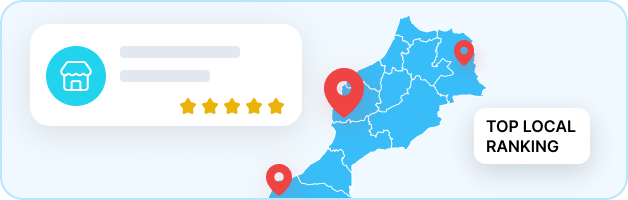
For accommodation, local SEO is not optional. A huge share of “hotel in Marrakech” and “riad near Jemaa el-Fnaa” searches are decided in Google Maps and the local pack, where your Google Business Profile is the deciding asset.
To win local visibility for a hotel or riad in Morocco:
- Claim and fully complete your Google Business Profile. Correct name, exact category, address, neighborhood, hours, booking link and a complete, accurate description. An incomplete profile loses to a complete one.
- Add strong, current photos. Rooms, rooftop, courtyard, breakfast, the entrance from the street. Accommodation is a visual decision, and fresh photos lift both clicks and rankings in Maps.
- Earn and respond to reviews. Reviews are decisive in travel. Ask happy guests at the right moment, and reply to every review, positive or negative, in a professional, human voice. Volume, recency and rating all matter.
- Be consistent everywhere. Your name, address and phone number must match across your website, Google Business Profile and every directory. Inconsistency confuses Google and weakens your local rankings.
- Use location and landmark keywords naturally. Travelers search by neighborhood and landmark (“riad in the medina”, “hotel near the Koutoubia”), so your profile and pages should reflect the real terms people use.
This is the same local-SEO discipline that helps any location-based business get found, and the fundamentals carry across sectors, as our guide to SEO for small businesses in Morocco explains.
Booking intent keywords and competing with OTAs
The most commercially valuable keywords in travel are the booking-intent ones: searches that signal someone is ready to commit. “Book Sahara tour”, “riad Marrakech book direct”, “Atlas Mountains day trip price”. These convert at a far higher rate than dreaming-stage queries, and they are where direct bookings are won or lost.
Here the real competitor is rarely another small operator. It is the OTAs and aggregators: Booking.com, Expedia, GetYourGuide, Viator and TripAdvisor. They have enormous domain authority and dominate generic terms. The strategy is not to fight them head-on. It is to win where you are genuinely the better, more specific answer.
The table below shows why direct bookings through your own SEO are worth fighting for, compared with relying on OTAs.
| Factor | Direct bookings via SEO | Bookings via OTAs / aggregators |
|---|---|---|
| Commission per booking | None, you keep the full margin | Typically 15 to 25 percent taken from each booking |
| Customer relationship | You own the guest data and contact | The platform owns the customer and the data |
| Reviews | Build on your own profile and site | Often locked inside the platform |
| Brand control | Your story, your photos, your voice | A standardized listing among competitors |
| Cost over time | Upfront effort, then compounding free traffic | A recurring toll on every single booking |
| Best used for | Building an owned, long-term asset | Extra discovery and filling gaps |
The realistic goal is not to abandon OTAs overnight. It is to treat them as one discovery channel while steadily growing the share of direct, commission-free bookings you control. You beat OTAs by:
- Targeting specific, long-tail terms they cannot tailor to your exact business (your neighborhood, your named experience, your property).
- Owning your Google Business Profile and Maps presence, where OTA listings are weaker and your direct contact can appear first.
- Offering a reason to book direct, such as a better rate or a small perk, on a fast, trustworthy website that ranks for the searches your guests run.
The same “own your channel instead of renting it” logic drives results in other sectors too, which is why operators selling online often pair travel SEO thinking with e-commerce SEO in Morocco.
The Moroccan tourism context
Morocco’s tourism market has a few characteristics that shape how SEO should be done here.
- It is overwhelmingly international and English-led. The decision-makers are often abroad, researching in English, comparing Morocco against other destinations entirely. Your content competes for attention, not just for keywords.
- It is trilingual on the ground. English, French and Arabic all matter depending on the audience, which makes multilingual SEO a real, technical requirement rather than a nice-to-have.
- It is intensely visual and trust-driven. Travelers are committing money to a place they have never seen. Photos, reviews and clear, honest information do the heavy lifting, and search engines reward exactly those signals.
- It is concentrated around iconic destinations and experiences. Marrakech, Fes, the Sahara, Chefchaouen, the Atlas and the coast attract enormous, predictable search demand. That demand is winnable with the right pages, but it is also where competition is fiercest.
- Mobile and speed matter more than average. Travelers research on phones, often on the move and on variable connections. A slow site loses them before the page even loads.
Common mistakes in travel SEO
Avoiding these errors puts you ahead of most of the market:
- Only an English homepage, no depth. A single page cannot rank for dozens of destinations and experiences. You need dedicated pages.
- Translation instead of localization. Auto-translated pages with no hreflang split your authority and match nobody’s actual search terms.
- Ignoring the Google Business Profile. For hotels and riads, an incomplete or unclaimed profile hands the local pack to competitors.
- Publishing seasonal content too late. Content that is not live and ranking before the booking window misses the demand entirely.
- Chasing only giant generic keywords. Trying to outrank OTAs on “Morocco tours” wastes effort that would win you ten specific, convertible searches.
- Thin, generic pages. Stock descriptions that could apply to any operator do not rank and do not convert.
- No original photos. Using only stock imagery costs you trust and image-search visibility, both of which are decisive in travel.
- Treating SEO as a one-off. Rankings need maintenance, refreshed content and ongoing review management. A site left untouched slowly slides.
How we work
Our process for travel and tourism clients follows a consistent path:
- Research and audit. We map how travelers search for your destinations and experiences in each relevant language, audit your current visibility, and study how OTAs and direct competitors rank for the terms that matter to you.
- Strategy and architecture. We design a site structure with the right destination, experience and property pages, set up the multilingual framework with hreflang, and prioritize the work around your booking calendar.
- Content and on-page. We create or rewrite pages to match real search intent, structured for booking, with the depth and clarity that ranks and converts.
- Local SEO. For hotels, riads and activity providers, we optimize your Google Business Profile, Maps presence and review strategy.
- Technical foundation. We make sure the site is fast, mobile-first, correctly tagged and fully crawlable, because no amount of content ranks on a broken technical base.
- Measure and refresh. We track rankings, traffic and bookings, refresh seasonal content ahead of each window, and keep building on what works.
You can see the same approach applied to other location-led sectors, such as our work on restaurant SEO in Morocco, where local visibility and reviews are equally decisive.
Who travel SEO is for
This is for you if you sell travel in Morocco and want to depend less on platforms that tax every booking:
- Tour operators and DMCs building itineraries and multi-day trips.
- Riads, boutique hotels and guesthouses that want direct bookings instead of OTA-only ones.
- Travel agencies selling packages or custom trips to international visitors.
- Activity and experience providers offering tours, classes, adventures and day trips.
If travelers are finding your competitors on Google while you rely on commissions and ads, SEO is the channel that changes that. The earlier you start before your next peak season, the more demand you capture when it arrives. To talk about your specific destinations, properties and booking goals, get in touch through our contact page or learn more about the agency on our English homepage.