For a restaurant or cafe in Morocco, the difference between a full dining room and an empty one increasingly comes down to a single moment: when a hungry person reaches for their phone and types “restaurant near me” or “best brunch Casablanca.” If your business is not visible in that instant, the table goes to a competitor who is. SEO services for restaurants in Morocco exist to win that moment, again and again, by making sure your restaurant appears at the top of the map, in the organic results, and in the AI answers that an increasing number of diners now trust. This page explains exactly how we do that, why local and multilingual search behaves differently for food businesses, and what it takes to turn Moroccan and tourist demand into booked covers.
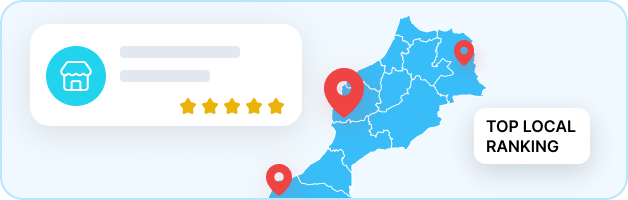
Why restaurants and cafes in Morocco need SEO
Answer first: people no longer ask friends where to eat, they ask Google, and in Morocco they ask from a phone, in the moment, with intent to dine soon. If your restaurant does not show up for those searches, you are invisible at the exact second the decision is made.
The way diners discover restaurants has shifted almost entirely to search. A few patterns dominate :
- “Near me” searches. Someone walking through Gueliz or sitting in a Rabat office types “café near me” or “pizza near me” and chooses from whatever Google shows first. These searches carry the highest intent of all: the person wants to eat now, nearby.
- Cuisine plus city. Queries like “Italian restaurant Casablanca,” “seafood Essaouira,” “vegan café Marrakech,” or “petit déjeuner Rabat” are how people plan a specific meal. Each one is a buyer signaling exactly what they want.
- Occasion searches. “Restaurant for birthday Casablanca,” “rooftop dinner Marrakech,” or “café with wifi Rabat” reflect a need your dining room may be perfectly suited to fill, if you rank for it.
- Tourist research. Visitors plan meals before they land. A traveler in Berlin searching “where to eat in the Marrakech medina” is choosing your restaurant weeks before they walk through the door.
Every one of these searches is a customer raising their hand. Restaurant SEO is the discipline of making sure your hand is the one they see. And because Morocco is a mobile-first, Google-dominated market, the venue that gets the local search right captures a disproportionate share of the foot traffic and the bookings.
The Google Business Profile: the centerpiece of restaurant SEO
Answer first: for a restaurant, the Google Business Profile is the single most valuable asset in search. It is what puts you on Google Maps and in the local pack, and for many diners it is the only thing they look at before deciding where to go.
A complete, well-maintained profile does the heavy lifting of local discovery. We treat it as a living storefront, not a one-time form. The elements that matter most :
- Accurate primary category and attributes. Choosing “Moroccan restaurant,” “café,” “pizza restaurant,” or “brunch spot” correctly, plus attributes like outdoor seating, vegetarian options, or takeaway, tells Google precisely which searches to show you for.
- Photos, and lots of them. Restaurants live and die on appetite appeal. Bright, current photos of dishes, the dining room, the terrace, and the storefront dramatically lift clicks and visits. Listings with strong photo libraries consistently outperform bare ones.
- An up-to-date menu. Adding your menu directly to the profile, with prices and dish names, lets diners decide before they arrive and helps Google match you to specific food searches.
- Correct hours, including holidays and Ramadan timings. Nothing loses a customer faster than arriving at a closed door. Accurate, special-day-aware hours protect both your reputation and your ranking.
- Reservation and ordering links. Connecting booking and ordering buttons turns a listing view directly into a confirmed table or order.
- Posts and updates. Regular posts about specials, events, and seasonal menus keep the profile fresh, which Google rewards and customers notice.
We optimize this profile in parallel with your website so the two send Google one consistent, powerful signal. If you run a small independent cafe, this work alone can transform your visibility ; if you are a group, we do it across every location.
Ranking in the local pack and on Google Maps
Answer first: the local pack is the boxed set of three map results that appears above the normal links for almost every restaurant search. Landing in it is the highest-value position a food business can hold, and it is won through relevance, distance, and prominence.
Google blends three core factors when it decides which restaurants to show on the map :
- Relevance. How well your profile and website match the search. Correct categories, a detailed menu, and content about your cuisine and city all raise relevance.
- Distance. How close you are to the searcher or the place named in the query. You cannot move your kitchen, but you can make sure Google knows exactly where it is.
- Prominence. How well known and well regarded you are, measured through reviews, links, mentions, and the consistency of your business information across the web.
Because you cannot change distance, the competitive battle is fought on relevance and prominence. That means a complete profile, a website that clearly states your cuisine and neighborhood, a steady stream of quality reviews, and consistent name, address, and phone details everywhere your restaurant is listed. Get those right and you climb into the three-result pack that captures the majority of local clicks. This is the same local-search discipline we apply for any small business in Morocco, tuned specifically for food and hospitality.
Reviews and reputation: your most visible ranking signal
Answer first: reviews influence both whether you rank and whether anyone chooses you once they see you. They are the rare SEO factor that customers read directly, which makes them doubly powerful for restaurants.
A hungry searcher comparing three listings will almost always pick the one with more recent, higher-rated, well-answered reviews. Google sees the same signal and rewards it. The reputation work that moves the needle :
- Volume and freshness. A steady flow of new reviews matters more than a large pile of old ones. We help you build simple, ethical habits that invite happy diners to leave honest feedback.
- Average rating. The visible star rating is the first filter most people apply. Protecting it through consistent food and service quality is part of the strategy.
- Responses. Replying to reviews, both glowing and critical, signals an engaged business to Google and reassures future guests. A gracious answer to a complaint often wins more trust than a perfect score.
- Keyword-rich reviews. When diners naturally mention dishes, neighborhoods, and occasions, those words reinforce the searches you want to rank for.
We never buy or fake reviews ; that path risks penalties and erodes the trust that makes the channel work. Genuine reputation, steadily built, is one of the most durable advantages a restaurant can own.
Menu and dish pages on your website
Answer first: your website should do what the Google Business Profile cannot, and dedicated menu and dish pages are where it earns rankings the profile alone will never reach.
Many restaurant searches are about specific food, not just a place to sit. “Where to eat couscous in Marrakech,” “best tiramisu Casablanca,” or “halal burger Rabat” are searches a well-built dish or category page can capture. We structure the site so each major dish, cuisine type, and dining occasion has a page worth ranking :
- A crawlable HTML menu, not a single flat PDF or image, so Google can read every dish name and description.
- Category pages for your strongest cuisines or sections, written to answer the searches around them.
- Signature dish pages for the items people travel for, with photos, descriptions, and the story behind them.
- Location pages for each branch if you operate several, so every neighborhood and city has a page targeting its local searches.
- Structured data so Google understands your menu, prices, hours, and reviews, which can earn rich results that stand out in the listings.
This is the same content-and-structure logic that drives strong ecommerce SEO in Morocco, applied to a menu instead of a product catalog. The principle is identical: give Google a clear, readable page for every thing people search for, and you become eligible to rank for all of it.
Mobile and “near me” intent
Answer first: nearly all restaurant discovery in Morocco happens on a phone, usually within minutes of wanting to eat, so a fast, flawless mobile experience is not a nice-to-have, it is the whole game.
Because Google indexes the mobile version of your site first, and because your diners are physically on their phones when they search, mobile performance directly shapes both your ranking and your conversion. The essentials we get right :
- Speed on mid-range Android phones, not just on a fast office connection. A menu that takes five seconds to load loses the hungry visitor.
- Tap-friendly buttons for calling, getting directions, viewing the menu, and booking a table, so the path from search to seat is one or two taps.
- A readable menu on a small screen, never a pinch-and-zoom PDF.
- Click-to-call and click-to-navigate that work instantly, because “near me” searchers act immediately.
When the mobile experience is frictionless, the high intent of a “near me” search converts into a real visit. When it is clumsy, that intent leaks away to a competitor whose site simply works.
Food delivery platforms versus your own site
Answer first: delivery apps bring volume but take your margin and your customer data ; your own search presence brings diners you own and orders that cost you nothing per transaction. The winning strategy uses both deliberately, not by accident.
Aggregators have a place, but understanding the trade-off keeps you from depending on channels that quietly erode your profit.
| Factor | Your website + Google Business Profile | Delivery apps and aggregators |
|---|---|---|
| Who owns the customer | You ; their visit and data are yours | The platform ; you rarely see the customer |
| Cost per order | No per-order commission | High commission on every order |
| Brand visibility | Builds your restaurant’s name in search | Builds the platform’s brand, not yours |
| Reservations and dine-in | Direct table bookings and walk-ins | Mostly delivery and takeaway only |
| Ranking benefit | Strengthens your own SEO and local pack | Helps the platform rank, not you |
| Control over presentation | Full control of photos, menu, story | Limited to the app’s template |
The honest takeaway is that delivery platforms are useful for incremental orders, but a restaurant that relies on them alone rents its customers at a steep price. Building your own organic visibility through Google means the diners you attract are yours to keep, and every direct booking or walk-in protects the margin the apps would otherwise take.
Multilingual menus: French, Arabic, and English
Answer first: Morocco is multilingual, and a single-language website quietly turns away customers who search in the languages you ignore. Matching your menu and pages to French, Arabic, and English unlocks audiences each other language cannot reach.
The language mix is specific to your location and clientele, and getting it right is one of the highest-return decisions in Moroccan restaurant SEO :
- French is the default language of dining searches for a large share of Moroccan customers, and for most urban restaurants it is the non-negotiable starting point.
- Arabic and Darija phrasing reaches a growing and underserved audience, particularly on mobile and through voice search, where many competitors have no presence at all.
- English is essential for any restaurant serving tourists. In Marrakech, Fez, Essaouira, and Agadir, a visitor researching “best restaurant in the medina” or “vegetarian café Marrakech” is searching in English weeks before arriving.
We build menu and key pages in the languages your guests actually use, with correct international tagging so Google serves the right version to the right searcher. A restaurant in a tourist district that exists only in French is invisible to a huge slice of its most valuable, highest-spending customers. The same multilingual logic underpins our travel SEO work in Morocco, where reaching international visitors in their own language is the entire point.
The Moroccan dining and tourism context
Answer first: Morocco’s food scene sits at the intersection of a young, mobile, dining-out local population and one of the world’s great tourism destinations, which means restaurant SEO here serves two very different audiences at once.
On one side are local diners, increasingly eating out, browsing on their phones, and deciding in the moment based on the map pack and reviews. On the other are millions of international visitors who research, compare, and shortlist restaurants long before they travel, often in English and often weeks ahead. A restaurant in Marrakech, Fez, or Essaouira that ranks well captures both: the resident looking for Friday dinner and the tourist planning their trip from abroad.
This dual audience shapes everything. The local diner rewards a complete profile, fresh reviews, and a fast mobile site. The tourist rewards English content, evocative photos, signature dish pages, and presence in the AI answers and overviews they now consult while planning. Seasonality matters too: tourist-heavy cities see demand swing with the travel calendar, and a smart SEO strategy positions you to capture each wave. Understanding this context is what separates generic optimization from restaurant SEO that actually fits the Moroccan market.
Common restaurant SEO mistakes
We see the same avoidable errors hold back excellent kitchens that simply are not found online :
- A menu trapped in a PDF or image. If Google cannot read your dish names as text, it cannot rank you for them. The menu must be crawlable HTML.
- A neglected or unclaimed Google Business Profile. Missing hours, outdated photos, or wrong categories quietly cost you the map pack every single day.
- Ignoring reviews. Not inviting reviews, and not replying to them, surrenders the strongest local signal and the first thing diners read.
- Single-language sites in multilingual or tourist areas. Serving only French in a district full of English-speaking tourists leaves the highest-value covers to competitors.
- Slow, clumsy mobile experiences. In a phone-first market, a heavy or hard-to-navigate site loses diners before the menu even loads.
- Total dependence on delivery apps. Relying on aggregators for visibility means renting your customers and surrendering your margin and your data.
- Wrong or inconsistent hours. Sending a hungry customer to a closed door earns a bad review and a lost regular.
How we work
We run restaurant SEO as a clear, repeatable process so you always know what is happening and why. You can see how this fits into our wider SEO services and overall approach.
- Audit. We start with a full review of your Google Business Profile, website, menu structure, reviews, mobile performance, current rankings, and local competitors. The audit shows exactly where the fastest wins are.
- Profile optimization. We complete and sharpen your Google Business Profile: categories, attributes, photos, menu, hours, and booking or ordering links, so it competes for the map pack from day one.
- Website and menu pages. We build or rebuild crawlable menu, cuisine, dish, and location pages, optimized for the cuisine-and-city searches your guests use, in the languages they use.
- Reviews and reputation. We put ethical systems in place to grow genuine reviews and respond to them, strengthening both ranking and trust.
- Multilingual setup. We implement the right language mix with correct international tagging so French, Arabic, and English searchers each find the right version.
- Reporting. We track rankings, map pack visibility, calls, direction requests, and bookings, and report on them in plain language so you see covers gained, not just activity.
Who restaurant SEO is for
Answer first: it is for any restaurant or cafe in Morocco that wants more diners finding it directly through Google, instead of paying commissions to aggregators or relying on luck and foot traffic.
It is for the independent cafe in Rabat that wants to own its neighborhood’s “near me” searches. It is for the medina restaurant in Marrakech that wants tourists to discover it months before they arrive. It is for the multi-branch group that needs every location ranking in its own city. It is for the new opening that has to be found from day one, and the established favorite quietly losing visibility to better-optimized rivals. If your future customers are searching for somewhere to eat, and in Morocco they overwhelmingly are, restaurant SEO is how you make sure they find your table first.
If that sounds like your restaurant, the next step is simple: see how we work on our SEO services page, review what an engagement looks like on our pricing page, and tell us about your venue through our contact page. We will start with an audit, show you exactly where the diners are slipping away, and build a plan that turns Moroccan and tourist search demand into a fuller dining room.